Building a Kenyan Food Lipidome Database (KFLD): Generating Evidence for Healthier Food Systems and Cardiometabolic Disease Prevention
Theme: From Evidence to Action for Healthier Food Systems in Kenya
RESEARCH & INNOVATION
Ongoing
About This Program
- Within its first year, ACMHR-K has established multidisciplinary research, capacity-building, clinical, community and policy programmes and has achieved publication in leading international journals. We are now seeking to build the evidence infrastructure required to support evidence-informed food and cardiometabolic-health policy in Kenya.
- Lipids are a diverse group of biological macromolecules known to play essential roles in energy storage, cellular structure, membrane function, signalling and metabolic regulation. Beyond their fundamental biological functions, alterations in lipid metabolism and specific lipid species have increasingly been associated with the development and progression of cardiometabolic diseases (CMDs), including cardiovascular disease, type 2 diabetes, obesity and metabolic disorders. The Alliance for Cardio-Metabolic Health and Research–Kenya (ACMHR-K) has established this programme to address critical gaps in the availability of reliable, country-specific data on the lipid composition of foods consumed and marketed in Kenya.
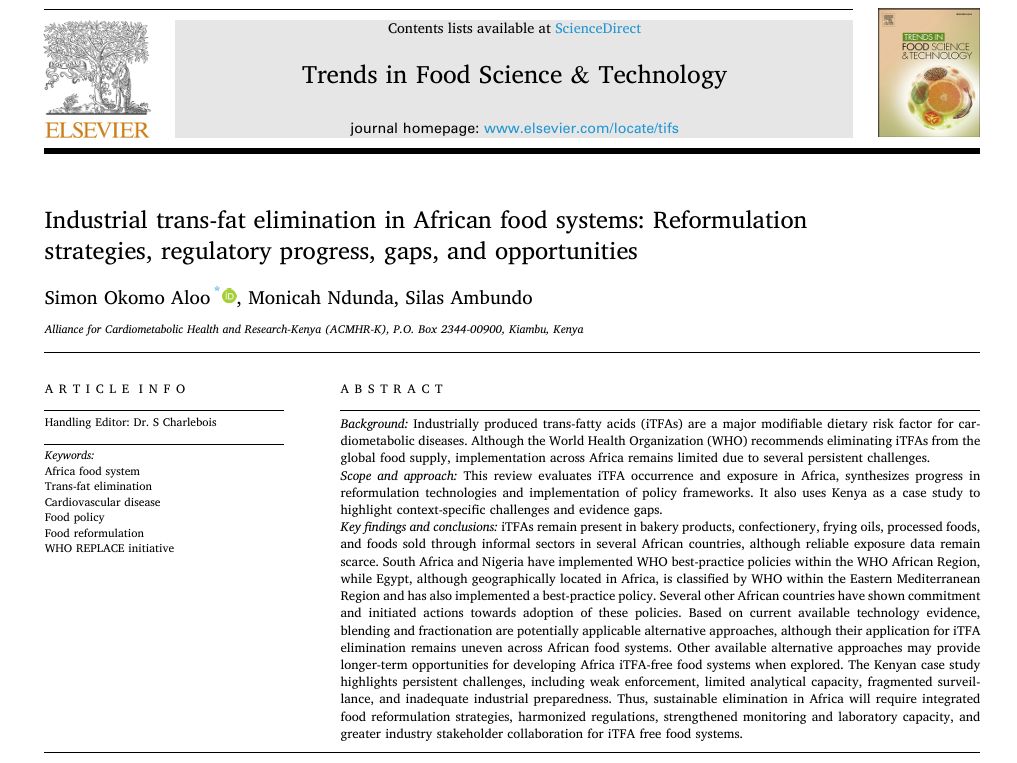
- The programme builds directly on ACMHR-K's recently published review in Trends in Food Science & Technology (Impact Factor: 17.3), a leading international journal in food science and technology. The review examined industrial trans-fat elimination across African food systems, including regulatory progress, food reformulation technologies, monitoring approaches and evidence gaps.
- Our review identified a major limitation across the African evidence base: there is insufficient current, systematic and analytically generated information on the actual trans-fat and fatty-acid composition of foods available in African markets. In Kenya, available evidence is fragmented, often based on limited food categories or individual studies, making it difficult to accurately determine population exposure, identify major dietary sources of industrial trans fats, evaluate differences between products and assess the effectiveness of regulatory measures and industry reformulation.
- There are also important gaps in the country's food composition data, particularly for commercially available processed foods, cooking fats and oils, fried foods and other products that may contribute substantially to dietary fat exposure. Limited longitudinal surveillance further makes it difficult to determine whether the composition of foods is changing following regulatory interventions and reformulation efforts.
- In response, ACMHR-K is developing a Kenya Lipid Food Composition and Surveillance Platform to generate, harmonize and curate high-quality analytical data on the lipid profiles of priority foods. The platform will provide a structured evidence base for understanding dietary lipid exposure, monitoring industrial trans-fat elimination and supporting healthier food reformulation.
Program Objectives
- Generate high-quality analytical data on the lipid composition of priority foods consumed and marketed in Kenya.
- Characterize industrial trans-fatty acids and other nutritionally important fatty acids.
- Identify major food categories and products contributing to dietary trans-fat and saturated-fat exposure.
- Establish a standardized and quality-assured Kenyan lipid food-composition database.
- Generate baseline data for monitoring changes in food lipid composition following regulation and industry reformulation.
- Support dietary exposure assessment and cardiometabolic health research.
- Provide evidence to inform food reformulation, regulatory monitoring and nutrition policy.
- Strengthen Kenya's capacity for analytical food-lipid surveillance to enhance fight against NCDs
Program Content
- Current evidence gaps in Kenyan food lipid composition data
- Industrial trans-fatty acids and their cardiometabolic implications
- Lipid and fatty-acid composition of Kenyan foods
- Saturated, monounsaturated and polyunsaturated fatty acids
- Food sampling and representative market surveillance
- Analytical approaches for fatty-acid and trans-fat determination
- Food-composition database development and data harmonization
- Dietary lipid and trans-fat exposure assessment
- Monitoring the impact of industrial trans-fat regulations
- Food reformulation and healthier-fat strategies
- Translation of food-composition evidence into policy and cardiometabolic-health interventions
Expected Outcomes
- Establishment of a quality-assured Kenyan Lipid Food Composition Database.
- Generation of new analytical evidence on the trans-fat and fatty-acid composition of Kenyan foods.
- Identification of important dietary sources of industrial trans fats and other potentially harmful dietary lipids.
- Improved understanding of the actual lipid exposure of Kenyan populations.
- Baseline evidence for evaluating the implementation and effectiveness of industrial trans-fat regulations.
- Data to support food manufacturers in developing and evaluating healthier reformulation strategies.
- Strengthened national capacity for food-lipid analysis and surveillance.
- Peer-reviewed publications, datasets and policy-relevant evidence.
- A foundation for developing a broader African lipid food-composition and surveillance network.
Start Date
Saturday, August 01, 2026
End Date
Thursday, April 27, 2028
Location
Nairobi, Kenya
Target Audience
Lipid scientists, food scientists, nutritionists, epidemiologists, clinicians, biomedical researchers, geneticists, public-health researchers, policymakers, regulatory agencies, food-industry professionals and early-career researchers.
Requirements
The programme requires multidisciplinary collaboration across food science, lipidomics, nutrition, epidemiology, public health and policy. The programme will be developed in phases, beginning with priority food categories and progressively expanding coverage to establish a comprehensive and sustainable lipid surveillance system for Kenya.
Program Information
- Category: RESEARCH & INNOVATION
- Status: Ongoing
- Start Date: Aug 01, 2026
- End Date: Apr 27, 2028
- Location: Nairobi, Kenya